Why EDI Failures Are Bleeding You Dry
You track inventory obsolescence. You optimize labor hours. You negotiate carrier rates.
But the most dangerous profit leak in your 3PL operation doesn't appear on any P&L line item. It's not captured in your WMS reports. Your accountants won't find it.
It's EDI.
And it's quietly eroding millions in margin while your leadership team focuses on everything else.
The $47,000 Mistake
A 500,000-square-foot regional 3PL recently lost a major retailer account. Not on service. Not on price. Not even on accuracy—their fill rates were 99.7%.
They lost it because 0.3% of their 856 Advanced Ship Notices contained errors.
This is how EDI kills. Quietly. Indisputably. Final.
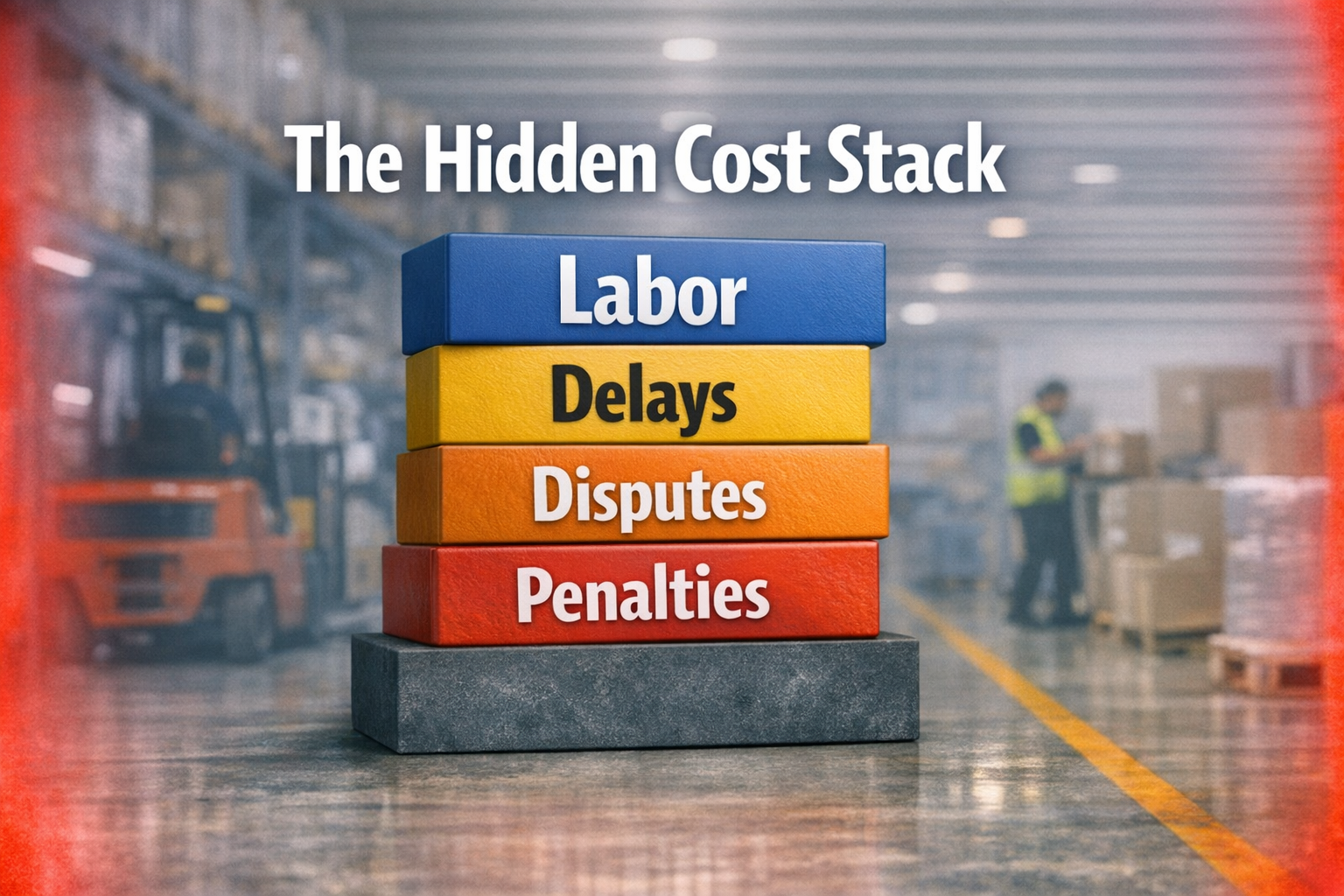
The Hidden Cost Stack
When EDI fails, you see the chargeback. What you don't see:
- • 4–6 hours of warehouse supervisor time per incident—chasing missing data, rekeying transactions, placating angry receivers
- • 2–3 days of delayed payment while invoices are manually corrected and resubmitted
- • 20–30% of ASN errors become receiving disputes that linger for months, aging in your receivables
- • One major retailer penalty can wipe the margin on 200+ orders
For a mid-sized 3PL processing 50,000 orders monthly, our clients consistently uncover $250,000–$500,000 in annual EDI-related leakage once they look beneath the surface.
That's not a technology cost. That's margin you already earned, disappearing into retail compliance black holes.
The Compliance Tax
Every major retailer—Amazon, Walmart, Target, Home Depot, Wayfair—operates on proprietary EDI requirements. Not standards. Requirements.
And they change constantly. Often without notice. Always without apology.
Your team is manually mapping:
- • Different PO formats (850, 875, 860—each retailer calls it something else)
- • Conflicting ship window calculations (calendar days vs. business days vs. "by end of day")
- • Varying GS1-128 barcode structures (what passes at Target fails at Lowe's)
- • Retailer-specific UPC exceptions and item master mismatches
This isn't integration. It's translation. And human translation fails at scale.
The Real Cost Isn't Transactional
Chargebacks are the symptom. The disease is capacity erosion.
Every EDI exception pulls your best people off value-added work to fight data fires. Your IT team manages file formats instead of architecting scalable infrastructure. Your operations leaders spend hours explaining to retailers why "the system didn't send what it was supposed to." Your finance team reconciles deductions instead of analyzing profitability.
The Real Cost Isn't Transactional
Here's what we've learned from auditing over 100 3PL operations: Most executives don't know how bad their EDI health is.
Why? Because the problems aren't visible at the top.
You're not managing EDI. You're surviving it
The Question You Should Be Asking
Not "How do we fix EDI?"
But "Who can ensure our retail compliance by eliminating EDI errors?"