

Traditional WMS systems keep warehouses running. They manage receiving, picking, packing, shipping, and inventory updates.
But the real problem is not whether the system runs.
It is how much effort the operation needs to keep it running smoothly.
In most warehouses, the system works, but teams spend increasing time fixing issues, handling delays, and adjusting workflows. These small inefficiencies add up to measurable costs over time.
Modern warehouse operations require systems capable of detecting issues, making decisions, and responding in real time. Traditional WMS systems are not designed for this.
Traditional WMS systems do not break often. They continue to run daily operations.
The problem is what happens around them.
Extra touches, manual fixes, delayed decisions, and repeated exceptions become part of daily work. Over time, these small inefficiencies add up to large financial losses.
These losses are hard to see because they do not appear as a single cost. They are spread across labor, inventory, service levels, and working capital.
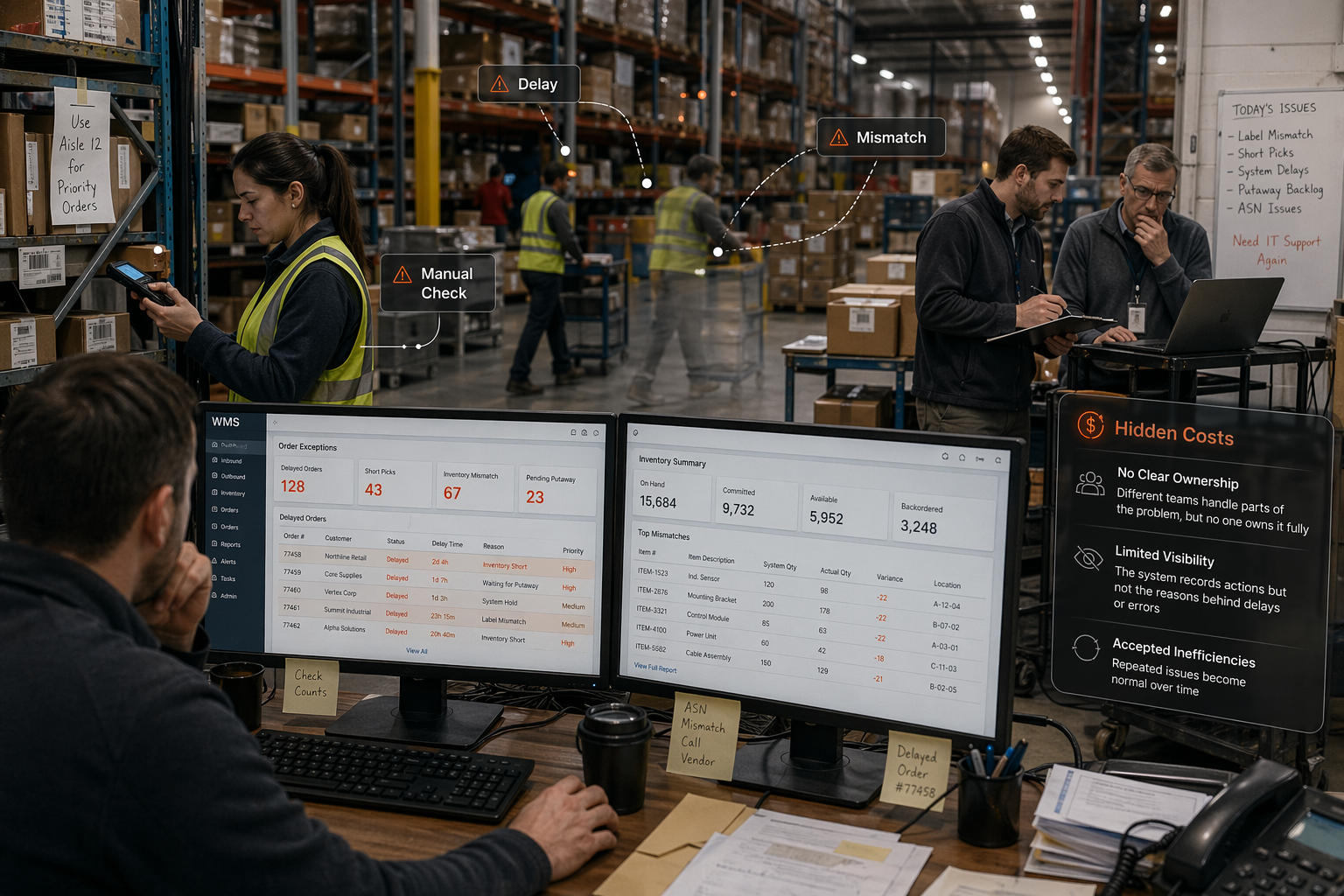
In many warehouses, the WMS becomes part of the operating habit. Teams adjust to its limitations instead of fixing them.
Hidden costs grow because of three reasons:
Different teams handle parts of the problem, but no one owns it fully
The system records actions but not the reasons behind delays or errors
Repeated issues become normal over time
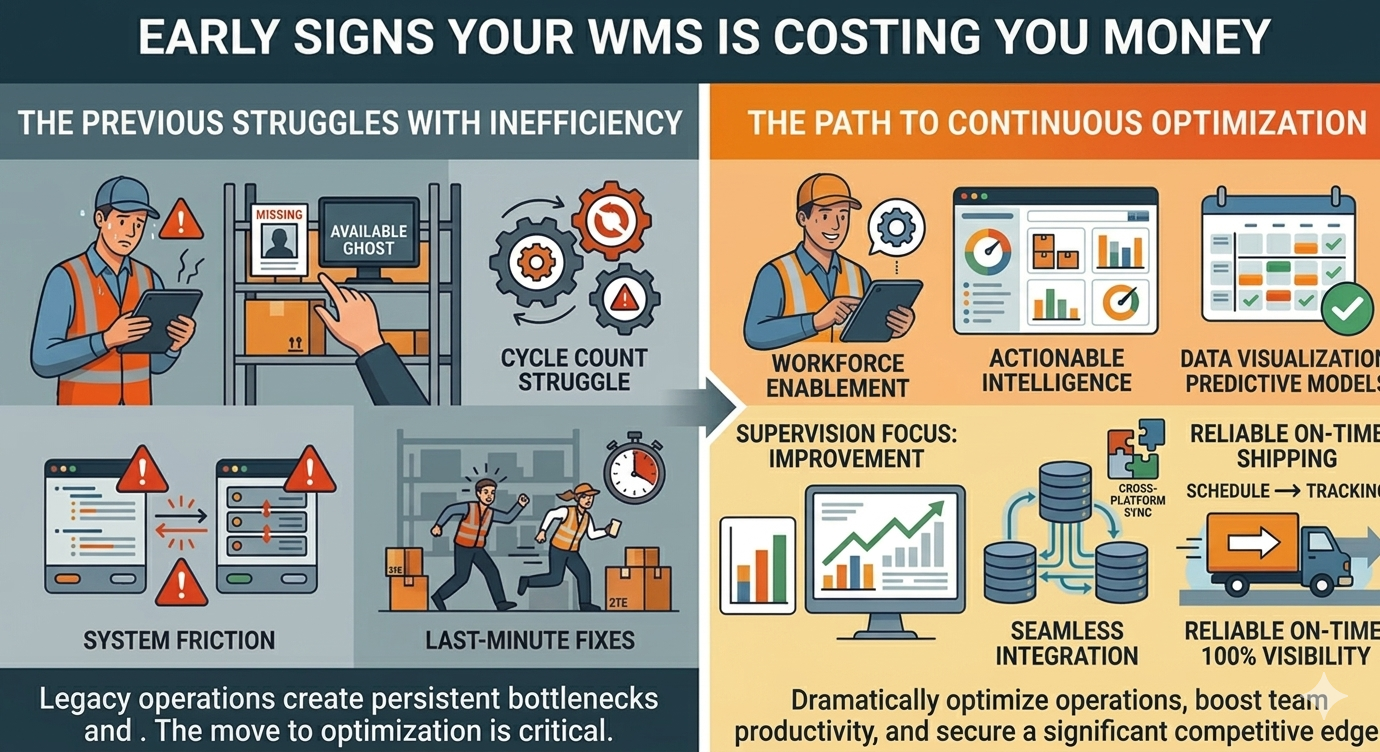
You may not see the cost directly, but the symptoms are clear:
These signs show that traditional WMS systems are creating hidden inefficiencies
You do not need perfect data to start. Simple metrics can show where money is being lost.
| Metric | What It Tells You |
|---|---|
| Exception rate | Frequency of short picks, damages, or order holds |
| Touches per order | Extra handling beyond the standard process |
| Inventory adjustments | Errors by location, zone, or shift |
| Replenishment urgency | Emergency vs planned work |
| Task delays | How long work wait before execution |
| System response time | Delays in transactions or integrations |
You do not need to replace your system to see improvement. Most gains come from better processes and smarter usage.
Define clear steps for each issue. Assign ownership. Set resolution time targets.
Count inventory when risk is high. Focus on fast-moving items and problem locations.
Monitor system connections. Clean master data. Automate common fixes.
Place high-volume items closer. Reduce travel time. Balance workload across zones.
Track backlog, delays, and risks in real time. Enable faster decisions.
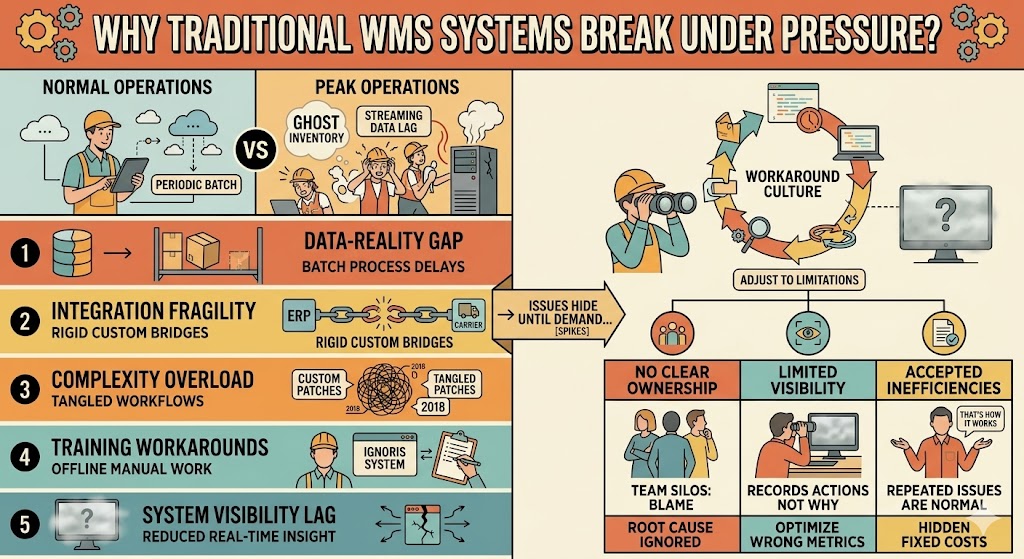
Traditional WMS systems struggle during peak operations. This happens because of deeper structural issues:
Poor data quality leads to wrong decisions
These issues do not always show during normal operations. They become visible when demand Increases.
An AI agent for WMS helps in areas where traditional systems struggle:
This reduces delays, errors, and recovery costs.
Instead of reacting to problems, your warehouse starts preventing them
Traditional WMS systems are not broken, but they are no longer enough for modern operations.
The highest cost is not the system itself. It is the hidden inefficiencies around it.
Extra work, delayed decisions, and repeated errors quietly reduce performance and profit.
These costs can be identified, measured, and reduced without replacing your WMS.
Traditional WMS systems focus on execution but lack real-time decision making and adaptability needed for modern warehouse operations.
Hidden costs include extra labor, manual fixes, inventory errors, delays, and inefficiencies that reduce overall performance.
Look for rising cycle counts, missing inventory, repeated integration issues, and dependence on manual fixes.
Yes, improving processes, integrations, and visibility can significantly improve performance without replacing the system.
AI agents use real-time data to detect issues early, recommend actions, and improve decision making and efficiency.
 We use cookie files.
We activate all cookies by default to ensure the proper functioning of our website,
advertisement, and analytics according to the Privacy
Policy.