AI Agents for WMS: A Guide to the Future-Proof
Autonomous Warehouse Management System
In modern warehouse operations, the gap between
receiving an order and shipping it is filled with
hundreds of decisions that directly affect your speed,
costs, and customer satisfaction. While traditional
Warehouse Management Systems provide visibility, AI
agents provide the intelligence that acts.
What are AI agents for Warehouse Management System?
An AI agent for warehouse management system is an
autonomous digital worker that integrates directly with
your ERP and WMS to sense, decide, and execute across
the entire fulfillment lifecycle. Unlike static
automation, these agents continuously learn from your
operational data to adapt to shifting conditions in real
time.
How do AI agents improve order fulfillment in the
warehouse management system?
AI agents bridge the
Decision Gap by moving
beyond simple data entry into active orchestration. They
optimize the fulfillment lifecycle through these key
areas of intelligence:
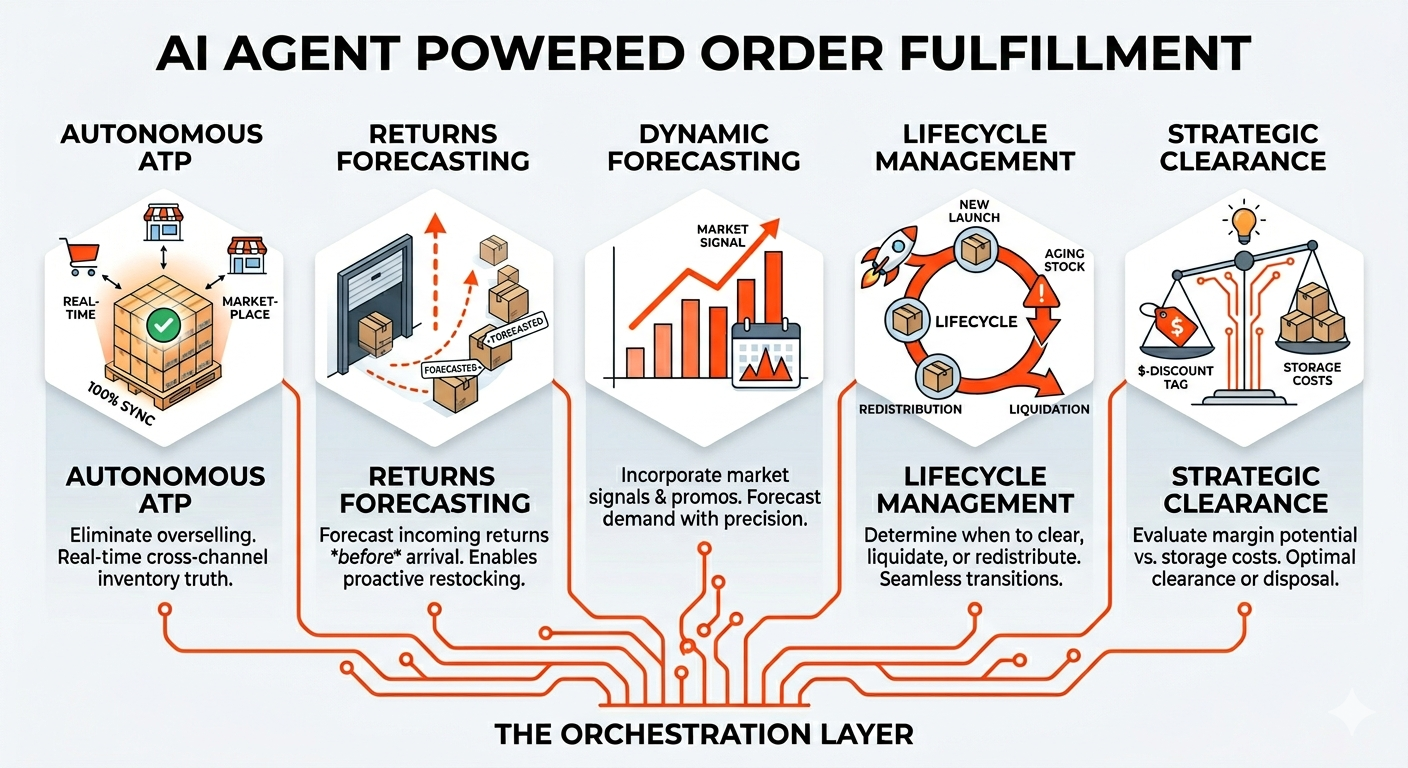
1. Autonomous Available to Promise (ATP):
These agents serve as a real-time source of truth for
your inventory. By calculating available stock across
every channel and accounting for open orders, in-transit
stock, and channel-specific latency, they eliminate the
risk of overselling.
2. Predictive Returns Forecasting:
In traditional reverse logistics, a return often does
not exist until it hits the warehouse dock. AI agents
change this by analyzing return patterns to forecast
incoming returns before they arrive, enabling proactive
restocking.
3. Dynamic Inventory Forecasting:
Moving beyond simple linear trendlines, agents
incorporate market signals and promotional calendars to
predict demand with surgical precision. This prevents
the panic of understocking while protecting cash flow.
4. Item and Design Lifecycle Management:
Agents determine when to clear, liquidate, or
redistribute stock based on channel-specific velocity
and inventory aging. This ensures seamless transitions
for new product launches without the risk of stranded
inventory.
5. Strategic Clearance vs. Discard:
AI agents evaluate margin potential and storage costs to
make the final call on whether to discount or dispose of
stock, protecting your bottom line from the costs of
aging goods.
AI agents improve warehouse efficiency and worker
productivity?
Beyond the initial decision of what to fulfill, the
efficiency of your physical floor depends on how you
move. Warehouse Execution Optimization is where AI
agents turn static layouts into high-velocity
fulfillment centers by automating millions of
micro-decisions.
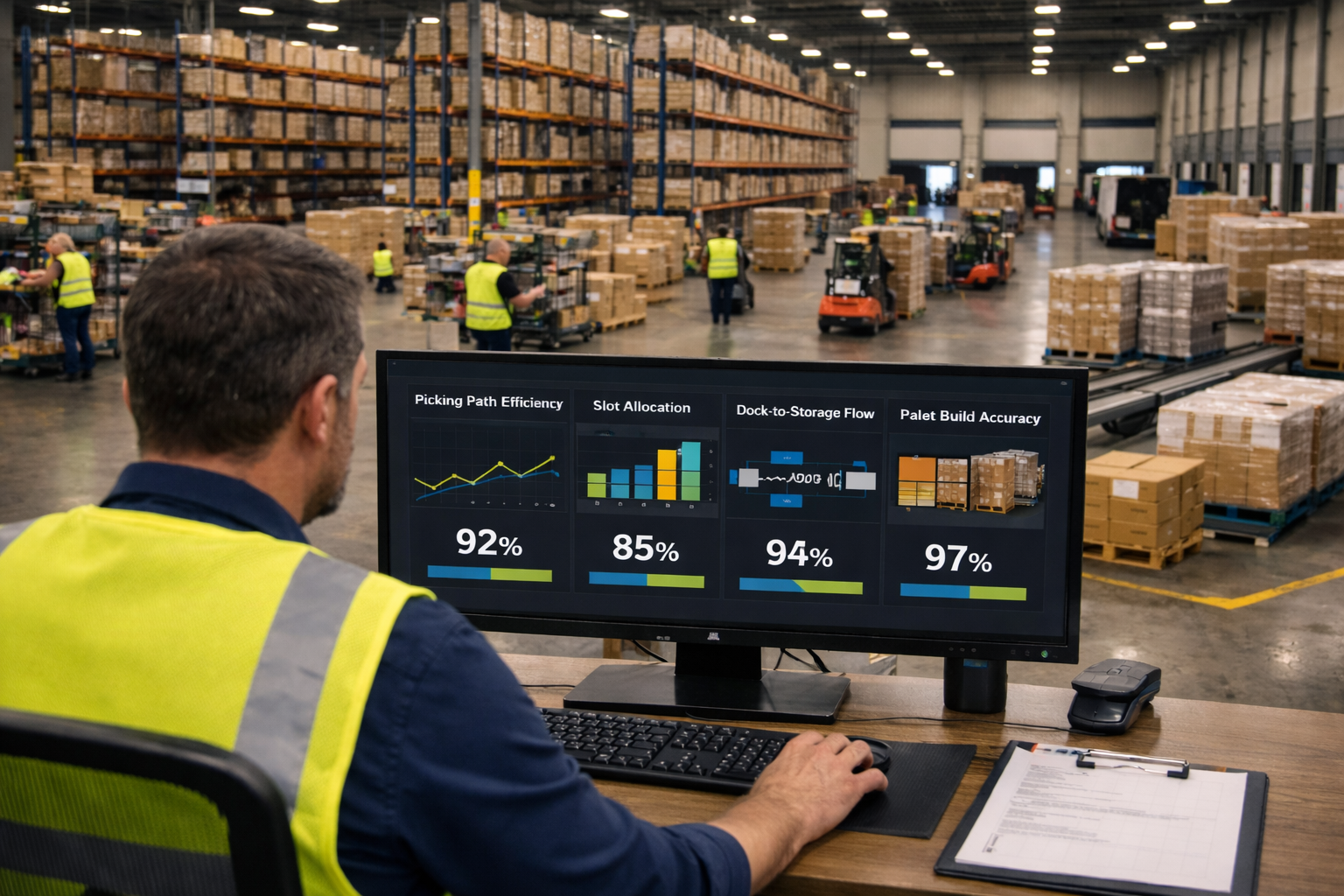
1. Picking and Picker Productivity:
AI agents dynamically assign pick waves based on order
urgency, worker location, and item velocity. By
analyzing pick paths in real time, these agents identify
manual bottlenecks and recommend adjustments to improve
throughput.
2. Strategic Slotting and Space Utilization:
A well-organized warehouse is a fast warehouse. Agents
continuously evaluate bin capacity and item velocity to
recommend optimal bin assignments, minimizing travel
time and maximizing storage density.
3. Optimized Put Away: When
stock hits the dock, agents determine the most strategic
storage location based on expected demand. This
proactive approach ensures high-velocity items are
exactly where they need to be for quick retrieval.
4. Auto Palletization and Packaging:
Agents calculate the most stable and space-efficient
pallet configurations. For individual orders, they
recommend the perfect box size and protective fill,
resulting in lower shipping costs and less material
waste.
What are the changes AI agents bring to inventory
planning and forecasting?
Effective inventory management depends on your ability
to look ahead. By integrating these agents into your
workflow, you move from reactive scheduling to a
proactive, data-driven strategy.
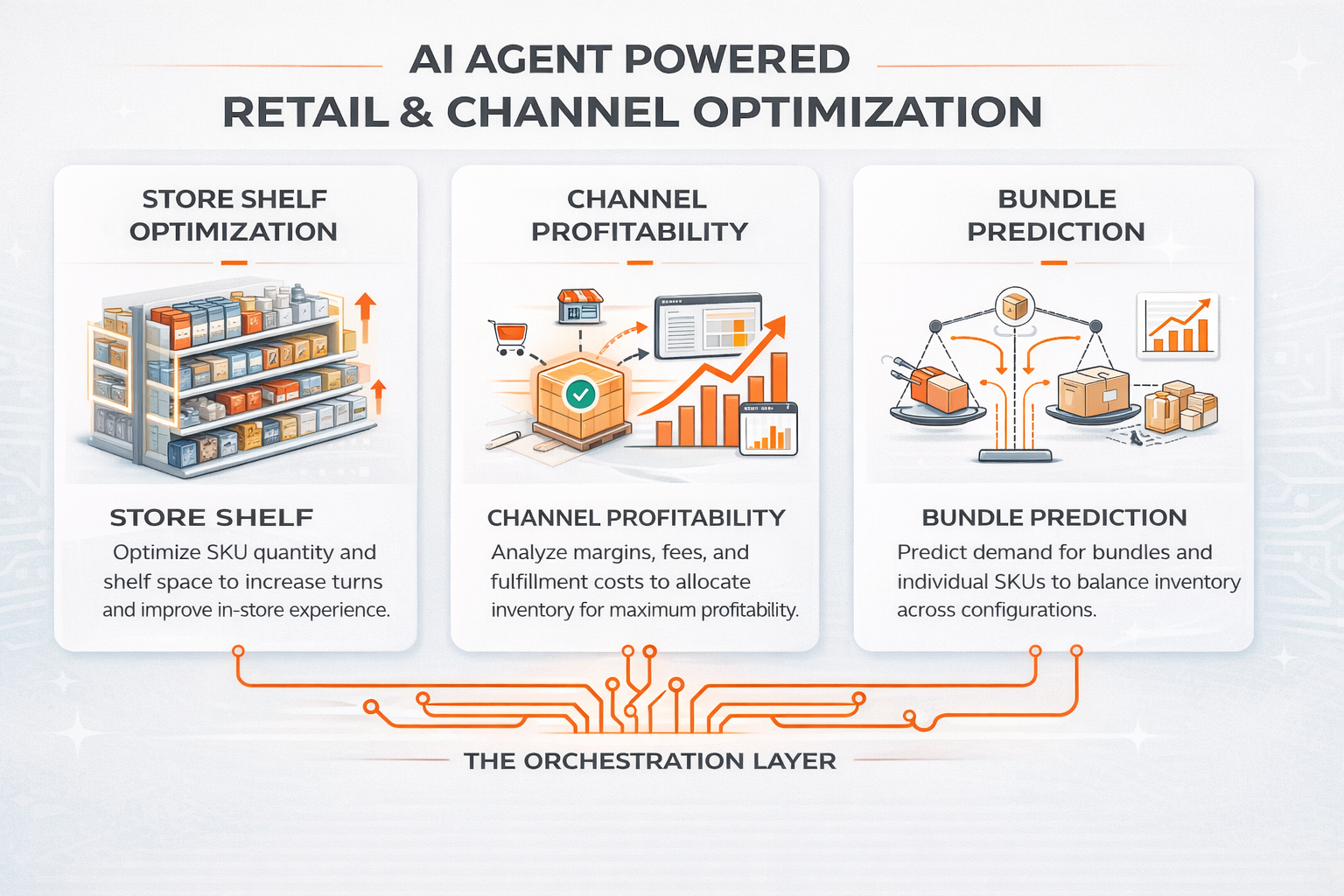
1. Store Shelf Quantity and Space Optimization:
For omnichannel operations, agents determine the ideal
quantity for each SKU and how shelf space should be
allocated to maximize turns and improve the customer
experience in every retail location.
2. Sales Channel Profitability and Forecasting:
AI agents analyze channel-specific margins, fees, and
fulfillment costs to recommend exactly where your stock
should be allocated for maximum profitability.
3. Group Item and Bundle Prediction:
For businesses selling bundles, agents predict demand
for group configurations based on component inventory
and seasonal trends, ensuring the right balance of kits
and individual units
Will AI agents simplify labor and shift management?
Your warehouse is only as fast as the team running it.
Labor and Shift Management powered by AI agents allows
you to move away from rigid staffing and toward an agile
operation.
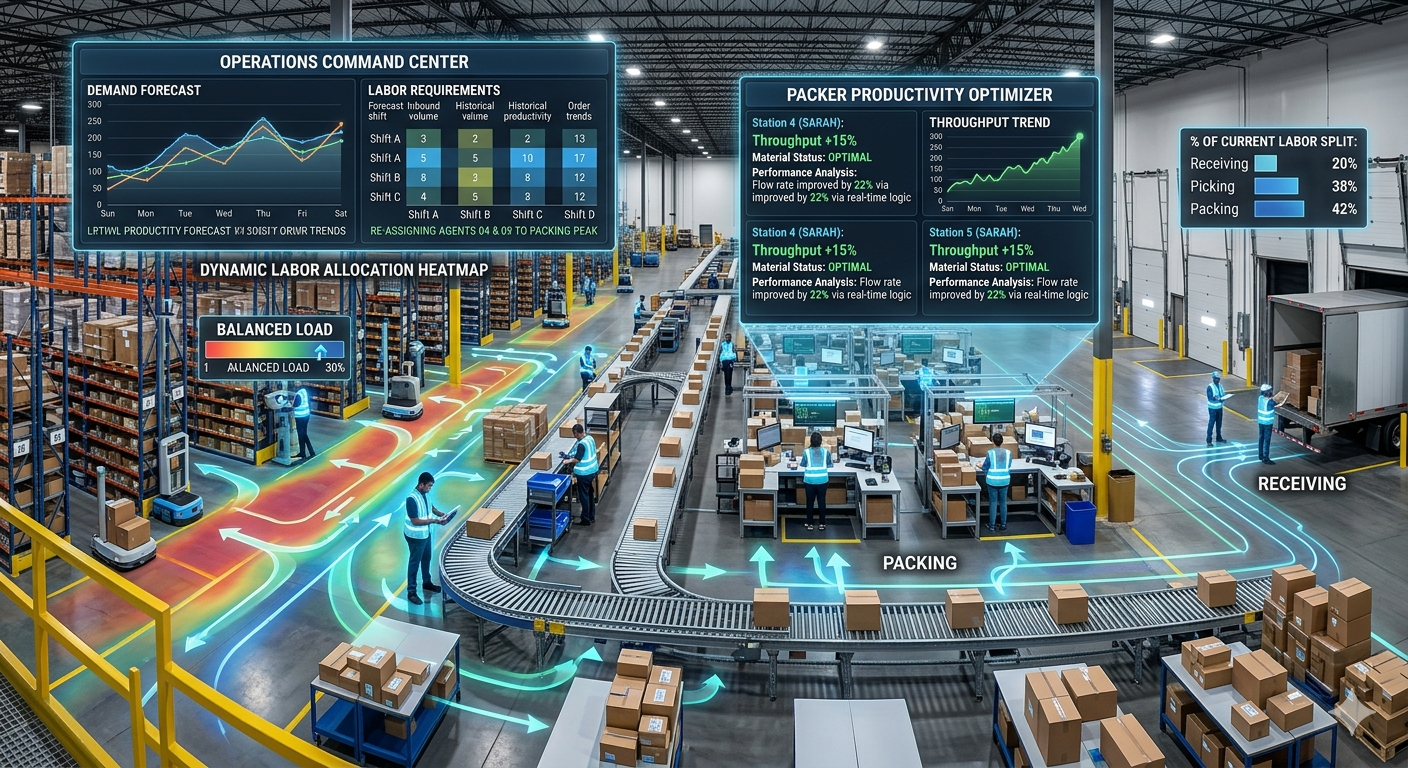
1. Forecasting and Labor Planning:
AI agents take the guesswork out of staffing by
predicting labor requirements for every shift based on
inbound volume, order forecasts, and historical
productivity patterns.
2. Dynamic Shift and Task Allocations:
Agents recommend how to allocate workers across picking,
packing, and receiving in real time,balancing the
workload across the floor and minimizing idle time.
3. Optimizing Packer Productivity:
By analyzing station performance and material
availability, agents identify specific opportunities to
increase throughput per worker, supporting team
efficiency during peak periods.
Why prioritize cycle counts with AI Agents instead of
manual schedules?
For maintaining inventory accuracy,it is essential for a
smooth fulfillment process.
Cycle Count Optimization
turns a repetitive chore into a strategic advantage
through
Intelligent Prioritization and Accuracy.
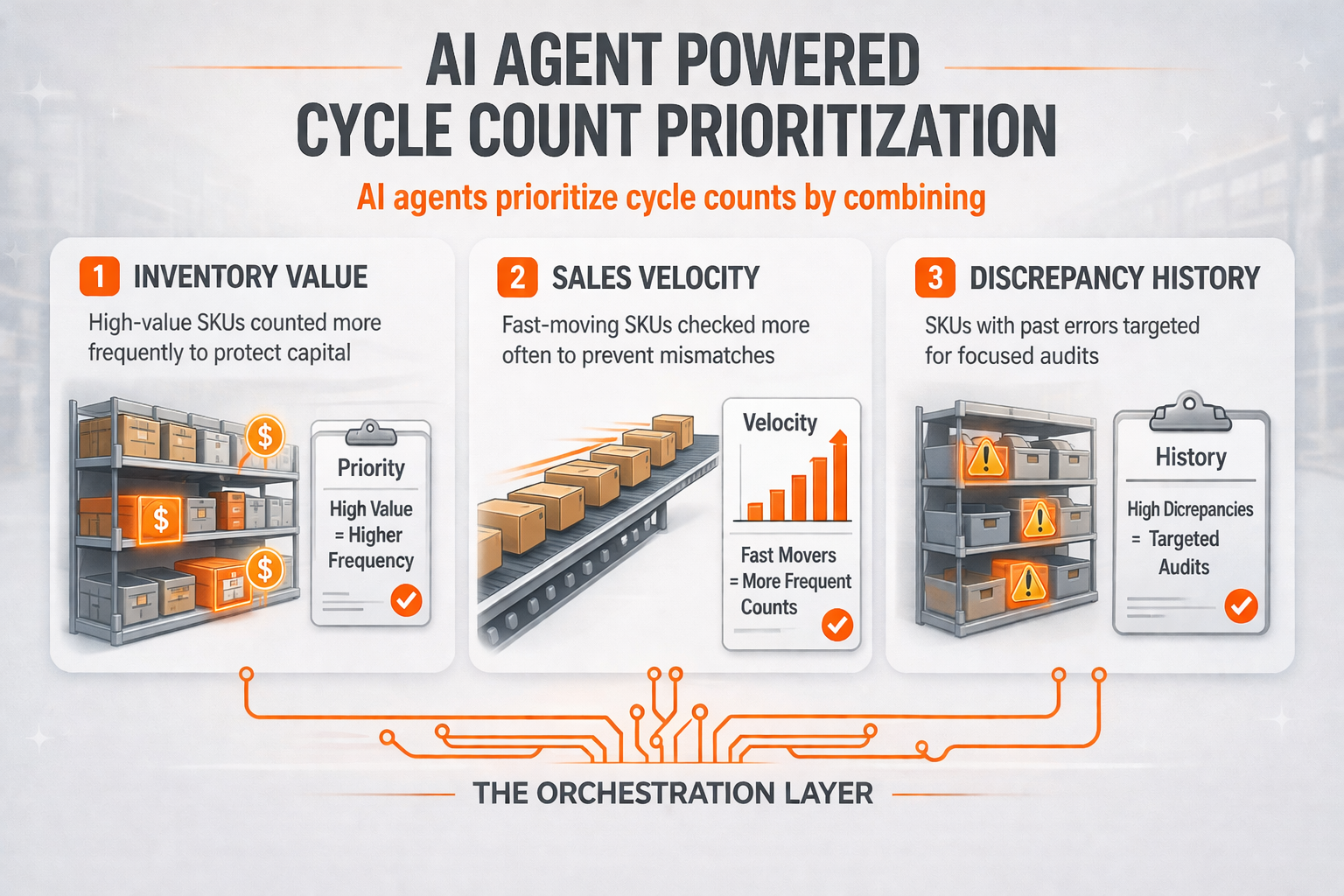
AI agents prioritize counts based on a combination of:
1. Inventory Value: Higher
frequency for high-capital items.
2. Sales Velocity: More
frequent checks for fast-moving items prone to
discrepancy.
3. Discrepancy History:
Targeted audits for SKUs with historical accuracy
issues.
This targeted approach maintains high accuracy across
your entire warehouse without consuming unnecessary
labor hours or disrupting your daily shipping schedule.
Frequently Asked Questions
1.Do I need to replace my current WMS to use AI
agents?
No. AI agents act as an autonomous accelerator for your
existing system. They connect to your data via API to
pull information and push instructions without a total
system overhaul.
2.How does an AI agent differ from standard WMS
automation?
Standard automation is reactive and rule-based. AI
agents are proactive and goal-oriented, resolving
bottlenecks autonomously rather than just alerting a
manager.
3.Can AI agents help with omnichannel complexity?
Yes. By providing Unified ATP logic, agents sync
inventory across e-commerce platforms and physical
stores to prevent ghost inventory.
4.What is the typical ROI?
Operations typically see a 20% to 30% increase in labor
productivity, reduced carrying costs, and higher order
accuracy.
The era of the static WMS is ending. In a world of
instant commerce, tracking where inventory is located is
no longer enough. You must know where it needs to be
before the order is placed.
By having AI agents connect to your Warehouse Management
System, you give your operational engine the brain it
needs to run at full capacity. You shift from constant
firefighting to autonomous orchestration, closing the
Decision Gap and future-proofing your fulfillment
strategy.
Stop managing your inventory. Start accelerating your
fulfillment.


 We use cookie files.